India’s electric mobility journey has crossed an important milestone.
According to data released by the Ministry of Power (PIB India), the country now has over 29,000 public EV charging stations installed across 36 states and Union Territories. The number reflects rapid progress and signals that India’s transition toward electric mobility is no longer theoretical — it is happening on the ground.
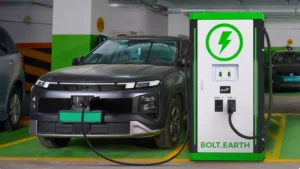
Yet a closer look at the distribution of these charging stations reveals a deeper story: strong growth in major urban regions, emerging momentum in second-tier states, and serious infrastructure gaps that still limit nationwide EV adoption.
Karnataka Leads India’s EV Charging Race — By a Clear Margin
At the top of the national rankings stands Karnataka, with 6,097 public charging stations, making it the undisputed leader in India’s EV infrastructure network.
The state’s dominance is driven largely by Bengaluru’s early EV adoption ecosystem, strong presence of automobile manufacturers, and proactive government policy support.
For EV users travelling across Karnataka today, range anxiety is rapidly becoming less of a concern.
Maharashtra follows in second place with 4,155 charging stations, supported by expanding EV infrastructure in Mumbai, Pune, and surrounding urban corridors.
Together, Karnataka and Maharashtra alone account for nearly 35% of India’s total public EV charging network, highlighting how infrastructure growth remains heavily concentrated in a few leading states.
Top 10 States Driving India’s Charging Infrastructure Expansion
Government data clearly shows where India’s EV charging momentum is strongest:
| Rank | State / UT | Charging Stations |
|---|---|---|
| 1 | Karnataka | 6,097 |
| 2 | Maharashtra | 4,155 |
| 3 | Uttar Pradesh | 2,326 |
| 4 | Delhi | 1,967 |
| 5 | Tamil Nadu | 1,781 |
| 6 | Rajasthan | 1,531 |
| 7 | Kerala | 1,392 |
| 8 | Gujarat | 1,208 |
| 9 | Madhya Pradesh | 1,147 |
| 10 | Telangana | 1,066 |
These top 10 regions alone host nearly 85% of India’s charging infrastructure, while the remaining states and Union Territories share just 15% of the network.
This imbalance explains why EV adoption remains uneven across the country.
Delhi’s Charging Network Faces a Major Test Ahead
With 1,967 charging stations, Delhi currently ranks fourth nationwide — a strong number for a city-state.
However, the recently proposed Draft Delhi EV Policy 2026–2030 could dramatically increase pressure on the capital’s charging ecosystem.
The draft policy proposes:
- No registration of new ICE three-wheelers after January 2027
- No registration of new ICE two-wheelers after April 2028
- Mandatory installation of public charging stations at all OEM dealerships
If implemented as planned, Delhi will need to rapidly expand its charging infrastructure within the next two years to meet rising demand.
The policy ambition is clear. Now the infrastructure must match the pace.
States Quietly Building the Next Wave of EV Growth
Beyond the top-ranked states, several regions are steadily strengthening their charging networks and preparing for future EV adoption growth.
Notable performers include:
- Haryana — 935 stations, supported by proximity to Delhi and strong highway corridor demand
- West Bengal — 903 stations, driven by Kolkata’s expanding EV ecosystem
- Andhra Pradesh — 793 stations, with Visakhapatnam emerging as a key EV hub
- Punjab — 717 stations, especially along national highways
- Odisha — 623 stations, showing promising growth in eastern India
These states represent India’s second wave of charging infrastructure expansion, where adoption is building momentum alongside deployment.
The Infrastructure Gap Still Holding Back Nationwide Adoption
While some states surge ahead, others are still at the very beginning of their EV infrastructure journey.
For example:
| State / UT | Charging Stations |
|---|---|
| Chandigarh | 14 |
| Mizoram | 13 |
| Sikkim | 12 |
| Dadra & Nagar Haveli and Daman & Diu | 9 |
| Andaman & Nicobar Islands | 4 |
| Ladakh | 1 |
| Lakshadweep | 1 |
Island territories and mountainous regions like Ladakh naturally face deployment challenges.
However, the situation in Chandigarh, one of India’s best-planned cities, reflects a clear infrastructure gap rather than a geographical limitation.
Such disparities continue to slow EV adoption outside major metro regions.
India’s Charging Network Is Still Largely Urban-Centric
The current infrastructure pattern shows a strong concentration in:
- Tier-1 metro cities such as Bengaluru, Mumbai, Delhi, Chennai, Hyderabad, and Pune
- Major national highway corridors
- Petrol pump charging installations
- Commercial hubs, malls, and public parking zones
What remains missing is deep penetration across Tier-2 and Tier-3 cities.
Cities like:
Meerut
Nagpur
Surat
Bhopal
Coimbatore
Patna
represent millions of vehicle users — but still lack reliable charging density required for large-scale EV adoption.
What India Must Do Next to Sustain EV Growth
Crossing 29,000 public charging stations is a major milestone. Just a few years ago, the country had only a few hundred.
But the next phase of expansion must focus on reach — not just speed.
Three priorities now stand out:
1. Stronger state-level execution
States lagging behind must accelerate deployment through land allocation support, subsidy frameworks, and coordination with electricity distribution companies.
2. Reliable highway charging corridors
Installed chargers must remain functional, accessible, and maintained. A non-working highway charger creates more anxiety than no charger at all.
3. Expansion into Tier-2 and Tier-3 cities
These cities represent the next major EV adoption opportunity — provided charging availability improves quickly.
Final Thoughts
India’s 29,000+ public charging stations signal a decisive shift toward electric mobility.
States like Karnataka, Maharashtra, Uttar Pradesh, Delhi, and Tamil Nadu are leading the transition. But with 10 regions controlling nearly 85% of infrastructure, the national charging map remains uneven.
The foundation is strong.
The next real milestone will be reaching 1 lakh charging stations — distributed across every state, every highway corridor, and every emerging city in India.
That is when India’s EV revolution will truly become nationwide.